



Common Salesforce Product Questions Revenue Ops Teams Are Asking (and Why They Matter)
If you work in Revenue Operations, you’ve probably noticed that Salesforce product conversations have gotten more confusing over the last year, not less. New names are showing up in roadmap decks. Old names still exist, but they’re being described differently. And suddenly everyone is talking about “agents” instead of workflows.
We hear the same questions over and over from RevOps leaders:
What actually is Agentforce?
Is Data 360 just a rebrand of Data Cloud?
Did Sales Cloud, Service Cloud, and Marketing Cloud disappear?
And what does any of this change for how we run revenue?
Let’s break this down in plain language.
“Is Agentforce a real product, or just Salesforce marketing?”
This is usually the first question — and it’s a fair one.
Agentforce is a real Salesforce platform, not a concept slide. Salesforce describes Agentforce as its autonomous AI agent platform, designed to create intelligent agents that can reason, retrieve data, and take action inside Salesforce, using your actual CRM data and permissions.
You can see how Salesforce positions it directly on the Agentforce product page.
What’s important for Revenue Ops is how this differs from traditional automation. These agents aren’t just firing rules or flows. They’re designed to evaluate context, decide what to do next, and complete multi-step actions. That’s a meaningful shift — especially for teams responsible for process consistency and data governance.
“So where does Data 360 fit into all of this?”
Short answer: nothing in Agentforce works well without Data 360.
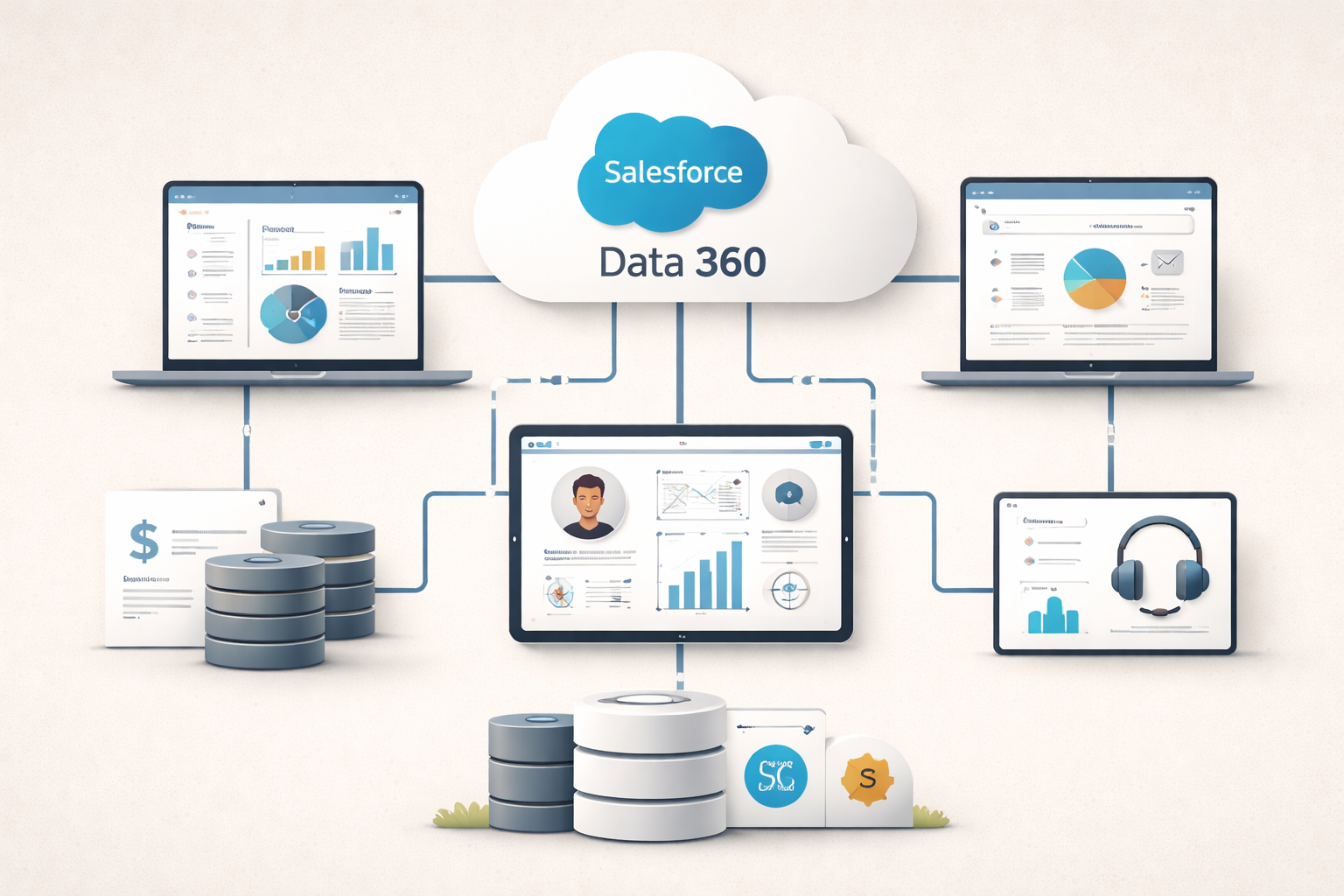
Data 360 (formerly Data Cloud) is Salesforce’s unified data layer. It connects CRM data with behavioral, transactional, and external data sources to create a real-time customer profile that every Salesforce product can use.
Salesforce’s own Data 360 guide explains this as the foundation for AI, personalization, and automation across the platform.
From a RevOps perspective, this matters because Data 360 is where identity resolution, data harmonization, and governance live. If your data model is fragmented or poorly defined, your agents will simply automate bad decisions faster.
Salesforce also explains how this data is activated across tools in its overview of how Data 360 works.
“Is Agentforce Sales just a new name for Sales Cloud?”
Not exactly.
Sales Cloud still exists and still handles the core CRM functionality — accounts, opportunities, forecasting, and reporting. What’s changed is how Salesforce is layering intelligence on top of it.
Agentforce Sales refers to the use of autonomous agents within Sales Cloud to support things like lead engagement, activity prioritization, pipeline updates, and forecasting assistance.
Salesforce continues to document this evolution within its Sales Cloud guide, which increasingly emphasizes AI-driven selling rather than just record management.
For Revenue Ops, this opens the door to more standardized sales behavior — but only if the underlying processes and definitions are solid.
“What about Service? How is Agentforce Service different?”
Agentforce Service focuses on customer support and case resolution. These agents can handle common service requests autonomously, suggest next-best actions to human reps, and escalate issues when needed.
Salesforce outlines how these service agents work in its help documentation on Service Agent functionality.
Operationally, this is less about replacing service teams and more about reducing noise. When routine cases are handled automatically, service data becomes cleaner, resolution times improve, and downstream metrics like retention and expansion become easier to trust.
“Is Agentforce Marketing replacing Marketing Cloud?”
No — but it is changing how Marketing Cloud is used.
Agentforce Marketing builds on Marketing Cloud, adding AI-driven orchestration, personalization, and decisioning powered by Data 360. Marketing Cloud remains the execution layer, while Agentforce Marketing introduces intelligence that adapts campaigns in real time.
Salesforce explains this shift in its Agentforce Marketing overview and continues to maintain details on core functionality via the Marketing Cloud editions page.
For RevOps teams, this matters because marketing engagement data is no longer isolated. It’s designed to flow directly into sales and service workflows, improving attribution and funnel visibility.
“Is this all just rebranding, or does it actually change how we operate?”
This is the question that really matters.
Some names have changed, yes — but Agentforce represents a functional shift, not just new packaging. Salesforce is moving from rule-based automation toward autonomous execution that operates across data, teams, and channels.
That has real implications for Revenue Ops:
- Governance becomes more important, not less
- Data quality directly impacts AI outcomes
- KPIs need to reflect automated actions, not just human ones
Salesforce provides a starting point in its Agentforce Getting Started Guide, but most RevOps teams quickly realize that success depends more on operating model decisions than on configuration alone.
Where Revenue Ops Teams Usually Get Stuck
Most teams don’t struggle with understanding the tools — they struggle with deciding:
- What should be automated
- What must stay human
- How to measure success when agents are involved
- Who owns failures when automation goes wrong
These are RevOps problems, not Salesforce problems.
This is where having a strong RevOps strategy makes the difference between “we turned it on” and “this actually improved revenue performance.”
Final Thought
Salesforce isn’t just adding AI features — it’s changing how work gets done inside the platform. Agentforce and Data 360 are powerful, but they amplify whatever foundation you already have.
For Revenue Ops leaders, the opportunity is clear: define the rules, align the data, and let the technology scale what already works — instead of exposing what doesn’t.

Related articles
Connecting Salesforce Data 360 to External Systems

Salesforce Report and Dashboard Customization Techniques

Understanding Salesforce Objects, Accounts, Contacts, Leads, and Opportunities

Common Mistakes Beginners Make in Salesforce (And How to Avoid Them)