











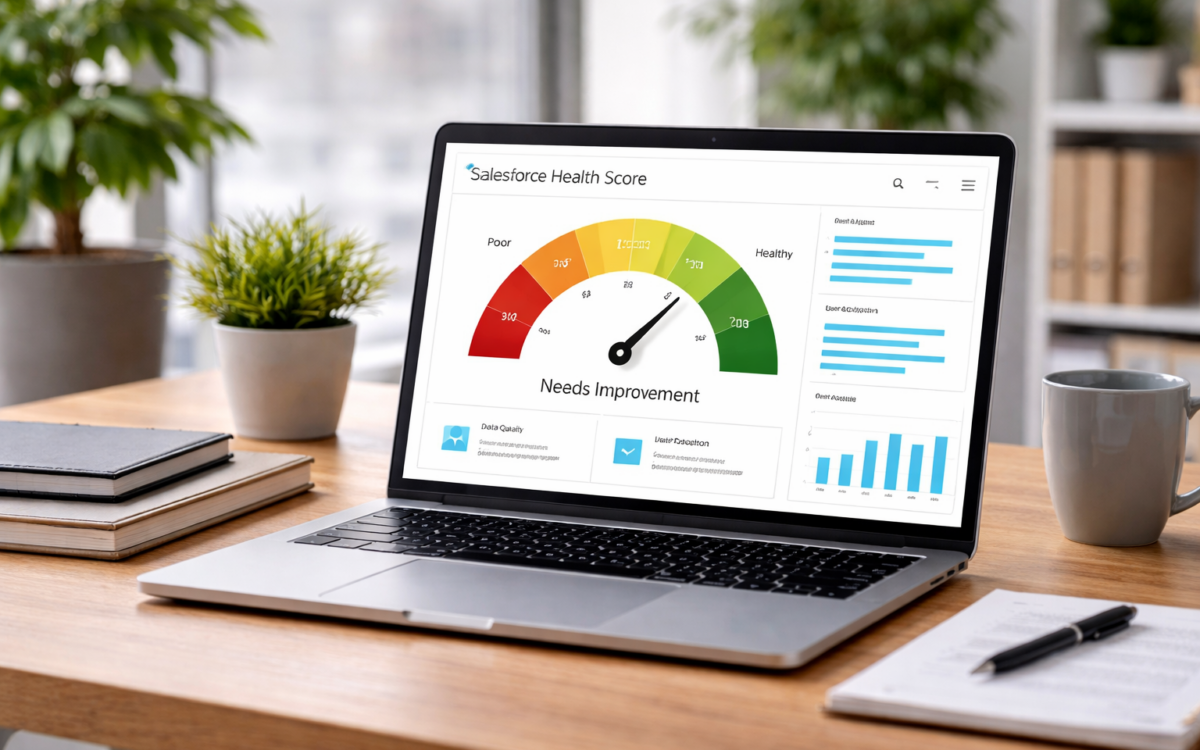
How do we know if our Salesforce instance is “healthy”?
At some point, every RevOps team hits this moment.
You’re in Salesforce every day. Dashboards are running. Reports exist. The team is using it (at least… mostly). But there’s this underlying question no one says out loud:
“Is this actually working the way it should?”
Because a Salesforce instance can look fine on the surface—and still be quietly causing problems underneath. Bad data, broken processes, low adoption, unreliable reporting… it doesn’t always show up immediately, but it always shows up eventually.
So let’s talk about what “healthy” actually means in a Salesforce environment—and how to recognize when something’s off.
A healthy Salesforce instance isn’t about how it looks—it’s about how it behaves
One of the biggest misconceptions is that a clean UI or a set of dashboards equals a healthy system.
It doesn’t.
A healthy Salesforce instance is one that supports how your business actually operates. It reflects your real sales process, your actual lifecycle stages, and your go-to-market motion—not some version of it that was set up two years ago and never revisited.
Salesforce itself talks about this idea of aligning CRM with business processes in their overview of what CRM is and how it drives growth. And that alignment is really the foundation of “health.”
If your system doesn’t match how your teams work today, it’s going to create friction—no matter how polished it looks.
You trust the data (and so does leadership)
This is probably the clearest signal.
If your leadership team is constantly questioning reports, asking for manual validation, or pulling numbers from multiple sources “just to be sure,” your Salesforce instance isn’t healthy.
In a strong environment, Salesforce is the source of truth. Forecasts are reliable. Pipeline data is consistent. Marketing and sales reporting align.
That doesn’t happen automatically—it requires clean data, clear definitions, and consistent usage. Salesforce emphasizes the importance of data quality in resources like their data management and governance guidance.
Because at the end of the day, if the data isn’t trusted, the system isn’t either.
Your team actually uses it (without being forced)
Adoption is one of those things that’s easy to measure and easy to ignore.
If reps are updating deals late, skipping fields, or working outside the system, that’s usually not a “people problem.” It’s a system design problem.
A healthy Salesforce instance feels intuitive. It fits naturally into daily workflows. It doesn’t require constant reminders or enforcement to keep it updated.
When adoption is high, it’s usually because the system is helping the team—not slowing them down.
Salesforce touches on this in their CRM implementation best practices, where usability and alignment are key drivers of success.
Your processes are clear—and reflected in the system
This is where a lot of instances quietly break down.
If you ask five people on your team what qualifies a lead, what stage a deal should be in, or when something becomes an opportunity, and you get five different answers—that confusion is going to show up in Salesforce.
A healthy instance doesn’t just track your process—it reinforces it.
Lifecycle stages are clearly defined. Lead routing is consistent. Handoffs between marketing, sales, and customer success are structured and visible.
And just as importantly, those processes are actually used.
You’re not overcomplicating things
Salesforce can do a lot. Sometimes… too much.
One of the most common signs of an unhealthy instance is overengineering. Too many fields. Too many validation rules. Too many workflows layered on top of each other.
It usually happens with good intentions—teams trying to capture more data or automate more processes—but it ends up creating friction.
A healthy Salesforce environment is intentionally designed. It captures what matters and removes what doesn’t.
That balance is what keeps the system usable as you scale.
Your marketing, sales, and data actually connect
With newer capabilities like Agentforce Marketing (formerly Marketing Cloud) and Data 360 (formerly Data Cloud), Salesforce has leaned heavily into creating a connected ecosystem.
The idea is simple: marketing automation, sales activity, and customer data should all live in one connected flow.
Salesforce explains how unified data enables better personalization and decision-making in resources like their overview of Data Cloud (now Data 360).
In a healthy instance, you can trace the full journey—from first touch to closed deal to expansion—without jumping between disconnected systems.
If that connection is missing, you’re only seeing part of the picture.
So how do you actually evaluate your Salesforce health?
Here’s the reality: most teams don’t realize their Salesforce instance isn’t healthy until something breaks.
Reporting stops making sense. Forecasts miss. Pipeline coverage feels off. Or leadership starts asking questions the system can’t answer.
That’s usually when a deeper audit happens. Because “healthy” isn’t about having Salesforce.
It’s about having a system that:
- reflects your actual revenue process
- produces data you trust
- and supports your team instead of slowing them down
Final takeaway
A healthy Salesforce instance doesn’t draw attention to itself.
It just works.
Your team uses it without friction. Your data is reliable. Your reporting answers real business questions. And your processes are clear and consistent across teams.
If that’s not your current experience, it’s not a failure—it just means your system needs to evolve with your business.
And honestly, that’s normal.
Salesforce isn’t something you set once and forget. It’s something you continuously refine as your revenue engine grows.
The key is knowing when to take a closer look—and making sure you’re building something your team can actually rely on.

Related articles

Is Salesforce worth it for small businesses?

What Data Should Be Migrated First?

How Long Does It Take to Implement Salesforce?

Salesforce Is Phasing Out Connected Apps — Here’s What the Spring ’26 Change Really Means